


Logistics serves as the "veins and arteries" of the real economy, connecting production and consumption, as well as domestic and foreign trade. Since the launch of the 14th Five-Year Plan, China’s regulatory framework for "multimodal transport" integrating road, rail, sea and air services has been continuously refined. In particular, international logistics via sea-rail intermodal transport has achieved substantial development, emerging as a crucial driver for enhancing the efficiency of economic operations.
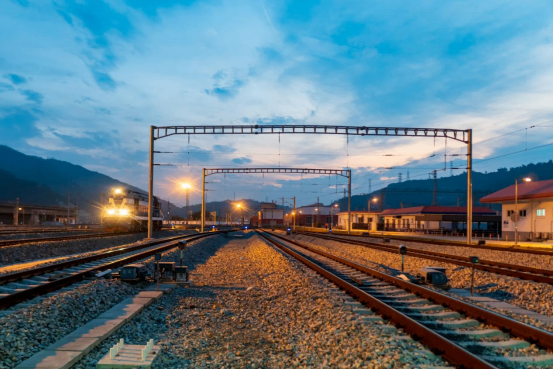
Image Source:699pic.com
Recently, 122 containers loaded with hybrid cars were transported directly by rail from Zhengzhou Inland Port to Qianwan Port Area of Qingdao Port, and then shipped to the UK. "Previously, export cargoes had to wait for inspection and release by port customs after arriving at the port yard before being gathered at the port for shipment," a staff member of the logistics company explained. "Thanks to the 'land-sea linkage and sea-rail direct transport' regulatory model introduced by customs, the logistics time has been shortened by 24 hours, which significantly cuts down our customs clearance time and costs, and further optimizes the eastbound sea-rail intermodal transport corridor."
Sea-rail intermodal transport is an international logistics mode for import and export cargoes. It involves transporting goods by rail to coastal ports for direct shipment by vessel, or by vessel to coastal ports for subsequent delivery by rail. The entire transportation process can be completed through "one-time declaration, one-time inspection and one-time release". Sea-rail intermodal transport involves multiple modes of transportation and requires close coordination among various stakeholders such as logistics enterprises, railway departments, port authorities and customs.
Under the "land-sea linkage and sea-rail direct transport" model, enterprises can complete the whole-process transportation of inland cargoes—from rail freight liner direct delivery, to direct loading upon arrival at the port, and to original-container shipment for export—with a single through bill of lading. This reduces the domestic transportation costs for provinces along the Yellow River Basin by approximately 20%.
"We are actively advancing the reform of 'single-document system' and 'single-container system' for sea-rail intermodal transport, promoting data interconnection between inland ports in the Yellow River Basin and terminal operation systems, and extending port functions such as cargo consolidation and stowage to inland areas," a staff member of Qingdao Customs stated.
Qingdao Port is the largest foreign trade port in northern China and the most convenient seaport outlet for the Yellow River Basin. Over half of the export cargoes from provinces including Henan and Shaanxi are shipped overseas via Qingdao Port, making sea-rail intermodal transport an important international logistics corridor for these cargoes to reach global markets.
"We have been continuously accelerating the integration of railway and port facilities, taking the lead nationwide in implementing the sea-rail intermodal transport model featuring 'port-front and station-back, integrated operation', and steadily improving the level of physical connectivity," a representative from Qingdao Port introduced. In the first 11 months of 2025, Qingdao Port handled 2.625 million TEUs via sea-rail intermodal transport, registering an 11% year-on-year growth and maintaining its leading position in China.