


The General Administration of Customs has data. In 2025, China’s industrial robot exports increased by 48.7% from last year. Export volume is higher than imports. This makes China a net exporter of industrial robots for the first time.
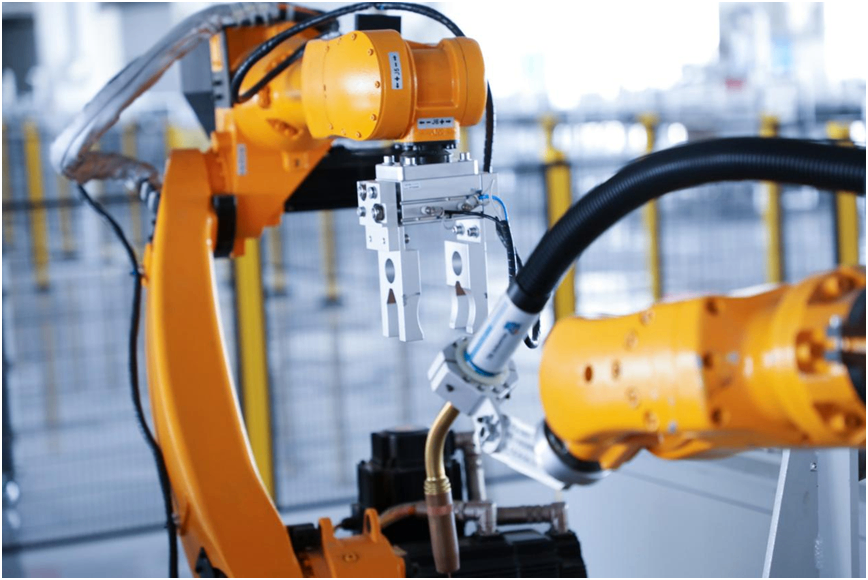
Image Source: 699pic.com
Zhu Shishui is the General Manager of MIR Industrial Robot Division. He thinks this big change comes from China’s manufacturing moving around the world. He says manufacturing relocation has two main ways. One way is moving back to high-end markets in Europe and the United States. The other way is moving production to new areas like ASEAN, Mexico and Eastern Europe.
Most industrial robots are used in cars, electronics, new energy, photovoltaics and lithium batteries. End-users are investing more overseas. Their equipment, production lines and industrial robots are exported too. Zhu says the next two to three years will see many “equipment + robots” going global together.
Overseas expansion is not just following others. It is also making active changes. The domestic market is very competitive. Overseas, you can get better results with the same effort. The market share is low there. So there is much room to grow. There is real need to replace labor too.
China’s industrial robots are entering a new era of going global. This confidence comes from years of technical and industrial development. In the past, imported brands controlled the industrial robot market. After more than ten years of hard work, domestic brands have overtaken foreign brands in the past two years. This trend will not change.
China is the world’s biggest industrial robot market. The International Federation of Robotics released the *World Robotics Report 2025*. It says China installed 295,000 industrial robots in 2024. That is 54% of the world’s total. Domestic suppliers have 57% of China’s market. They grow much faster than international brands.
Domestic robot brands have been used widely in China. They are now as good as foreign brands in product performance and brand influence. The *2025 China Manufacturing Powerhouse Development Index Report* shows something. In 2024, China’s index is similar to Germany and Japan. All sub-indices are growing. China is now in the second tier of global manufacturing powers. It has finished the first goal of building a strong manufacturing country. China is the fourth global manufacturing power after the United States, Germany and Japan.
Companies have two main ways to enter overseas markets. The first way is to target developed markets in Europe and the United States. This way is good for companies with strong independent technology. Europe and the US have high standards. They have strict rules for product performance, compliance and brand. But once you stand firm there, you can get great value.
The second way is to focus on new markets like Southeast Asia, Mexico and Eastern Europe. These areas care more about cost performance and service speed. They do not require the most advanced technology. This way is good for companies that are still improving products but offer flexible services.
China has the most complete industrial categories in the world. Many new fields need automation. These fields include lithium batteries and photovoltaics. These needs first appeared in China. Foreign brands do not have much experience in these fields. Domestic robots have taken part in updating production lines deeply. Domestic industrial robots are mature in new energy industries. Some are even leading. Only Chinese companies can provide full equipment solutions from upstream to downstream.
Domestic robots are more cost-effective. They are not just cheap. Their operation and maintenance costs are lower. This makes automation possible for more scenarios. Ease of use is another advantage. European and American robots need engineers with bachelor’s or master’s degrees to debug and maintain. Chinese robots can be used easily by college-level technicians.
Chinese companies have tried to combine robots and AI. They have made great progress in AI applications on robot bodies and practical use. It is not easy for Chinese industrial robots to stand firm overseas. First, there is brand trust. Chinese brands have a very small share in the global mid-to-high-end six-axis robot market. Second, there are compliance barriers. CE certification is just the basic requirement. Many countries have strict technical and safety standards to meet. More importantly, market rules are different. Price is not the key factor overseas. The procurement decision process is longer. Decision-making is more scattered. Chinese companies need to reach more decision-makers. They need to build trust over a long time.
Chinese industrial robots have shown their advantages in the domestic market. These advantages include cost, response speed and customization. The industrial chain has developed from nothing to being complete. Future growth will come from two places. One is making breakthroughs in high-value domestic scenarios. These include automotive spot welding and high-precision handling. The other is expanding more overseas. They will compete with foreign brands around the world.