


On April 16, 2026, the National Bureau of Statistics released the economic performance data for the first quarter, showing that the output of industrial robots rose by 33.2% year-on-year. This growth rate far exceeded market expectations, serving as a remarkable indicator of the intelligent transformation of the manufacturing sector.
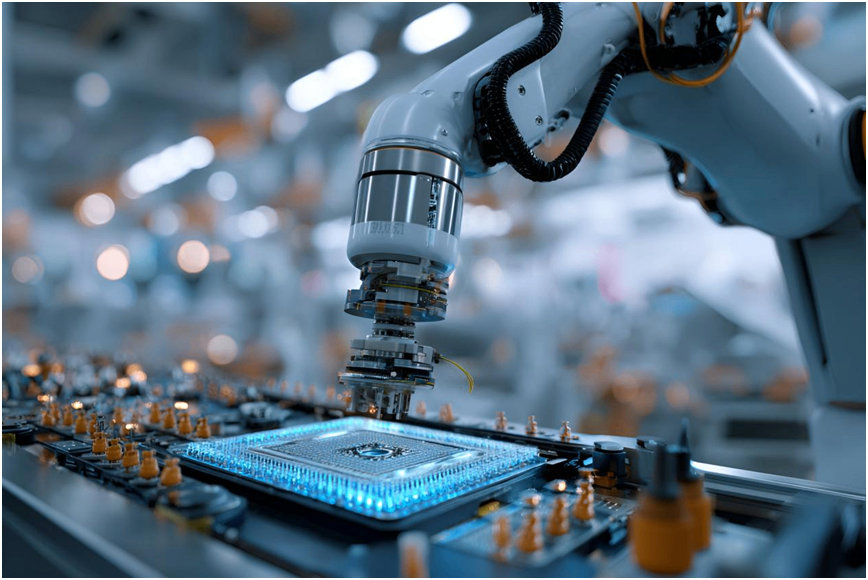
Image Source:699pic.com
At a press conference held by the State Council Information Office on the same day, relevant officials from the Ministry of Industry and Information Technology further elaborated on the implications behind the data. The accelerated application of emerging technologies such as artificial intelligence in the electronics and consumer goods sectors has driven rapid output growth of high-tech products including industrial robots and integrated circuits.
The official figures not only prove the accelerated intelligent upgrading of China's manufacturing industry, but also reveal that the global industry for industrial robots stands at the intersection of a new round of technological revolution and industrial transformation.
From automobile manufacturing and new energy industries to precision electronics and warehousing & logistics, industrial robots, as core equipment for smart manufacturing, are deeply integrated into the wave of global industrial upgrading and digital transformation, and have become a key benchmark for measuring a country's manufacturing sophistication.
Global Market Size: Steady Growth Amid Transformations
2.1 Continuous Market Expansion
According to the latest report 2025-2030 Global and China Industrial Robot Market Status and Future Development Trends released by China Research and Intelligence, the global industry of industrial robots maintains a steady growth momentum. The global industrial robot market reached 101.6 billion yuan in 2024, with a year-on-year increase of 3.5%. The market will reach 112.9 billion yuan in 2025 and 126.3 billion yuan in 2026. It keeps a strong annual growth rate.
The robot industry grows steadily. Its structure is changing, and its value is rising. China Research and Intelligence predicts the global robot market will hit 400 billion yuan in 2026. This is a 25% rise from 2025, showing great growth momentum. Such growth is jointly fueled by the intelligent transformation of manufacturing and the continuous expansion of service scenarios.
2.2 Divergence in Regional Market Patterns
Boasting massive manufacturing capacity, the Asia-Pacific region dominates the global industrial robot market. China is the world’s biggest single market for industrial robots. Its market size hit 46.7 billion yuan in 2024, a 4.0% year-on-year rise. It is set to reach 52.7 billion yuan in 2025 and over 60 billion yuan in 2026, taking up nearly half of the global market.
Europe leads in high-end manufacturing and autonomous mobile robot technologies. Germany, Japan and other major industrial countries keep technical advantages in core component research and production. North America sees rapid market growth due to manufacturing reshoring and digital upgrades.
The divergent regional landscape reflects both the restructuring of global manufacturing layout and the disparities in industrial development stages across different regions.
Conclusion: Seize Opportunities to Build a Smart Manufacturing Future
Driven by multiple factors including the intelligent transformation of manufacturing, rising labor costs and the restructuring of resilient supply chains, market demand for industrial robots keeps expanding, technological integration speeds up, and application scenarios become increasingly diversified.
Investors are advised to focus on enterprises with core technological strengths, prominent positions in niche markets and sound growth potential. Corporate strategists need to keep abreast of technological trends, optimize product portfolios and enhance core competitiveness. New entrants to the market should gain in-depth understanding of industrial characteristics, identify proper market niches and pursue differentiated development.
Looking ahead, as the core equipment for smart manufacturing, industrial robots will play an increasingly vital role in advancing the transformation and upgrading of global manufacturing and modernizing industrial and supply chains. Supported by favorable policies, technological advances and booming market demand, the global industry of industrial robots will embrace broader development prospects.